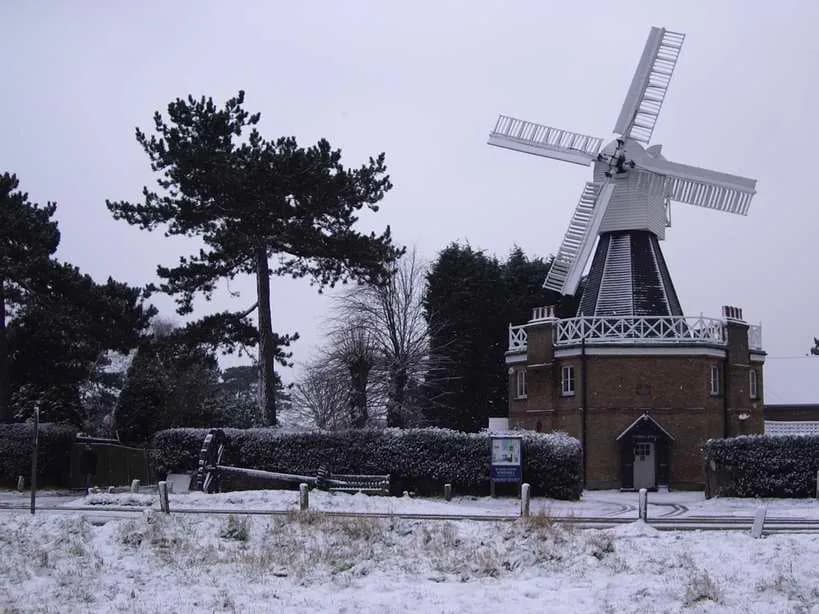
On Wimbledon Common stands a Grade II listed windmill that quietly contributed to one of the 20th century's most influential social movements. The Mill House behind Wimbledon Windmill provided the retreat where Robert Baden-Powell wrote portions of Scouting for Boys*, the book that launched the global Scout movement and has sold an estimated 150 million copies worldwide.
The Mill That Ground Corn for the Neighbourhood
Wimbledon Windmill was built in 1817 after carpenter Charles March of Roehampton secured permission to construct a public corn mill for "the advantage and convenience of the neighbourhood." The original structure was a hollow post mill, an unusual design more commonly found in the Netherlands than in England. After the mill ceased operation in 1864, the building was converted to accommodate six families, and later became housing for Wimbledon Common Rangers. A substantial reconstruction in 1893 transformed the windmill into the smock mill that visitors see today.
From War Hero to Writer on Wimbledon Common
Robert Baden-Powell had already achieved national fame by the time he arrived in Wimbledon. His 217-day defence of Mafeking during the Second Boer War had made him a household name, and his military training manual Aids to Scouting, published in 1899, had become unexpectedly popular with boys and youth organisations. By 1906, Baden-Powell was developing ideas for a civilian youth programme that would combine outdoor skills, self-reliance, and citizenship training.
The Honourable Mrs Maria Fetherstonhaugh, a soldier's wife and novelist, purchased the Mill House at Wimbledon Windmill in 1905 following the death of the previous owner, Colonel Tully. She offered Baden-Powell use of the house as a quiet retreat to write his new book. According to the Wimbledon Guardian, she visited him daily during his stay. The peaceful setting of Wimbledon Common, away from the distractions of London, provided the ideal environment for Baden-Powell to distill his military experience into a programme suitable for young people.
The Book That Changed Childhood
Scouting for Boys was published in six fortnightly instalments between January and March 1908, with the complete book appearing on 1 May that year. The volume carried the subtitle "A handbook for instruction in good citizenship" and featured illustrations drawn by Baden-Powell himself. Within a year of publication, the Boy Scouts Association had formed, with an initial census recording 100,000 Scouts. The movement's growth was rapid; by 1922, Scouting had expanded to 32 countries with over one million members.
The book's influence extended far beyond Britain. Translated into more than 35 languages, Scouting for Boys became the fourth best-selling book of the 20th century. Today, the Scout movement encompasses over 55 million members across 155 countries, making it one of the largest youth organisations in the world.
A Legacy Preserved in Wimbledon
The Baden-Powell family's connection to Wimbledon continued long after the book was written. Baden-Powell's elder brother, Frank, lived at 32 Parkside for eleven years until his death in 1933. Frank's son, Robert Harold Baden-Powell, later resided in a flat on Worple Road until his death in 1998.
The Wimbledon Windmill Museum opened in 1975, initially occupying only the first floor. An extension to both floors was completed in 1999 with support from the Heritage Lottery Fund. The museum now displays exhibits on windmill technology, local history, and the Scout movement's origins. The windmill sails still turn on selected weekends during the season.
Visiting the Windmill Today
The Wimbledon Windmill Museum operates from late March to late October each year, opening Saturday afternoons and Sunday and Bank Holiday mornings. Admission is free, though donations support the charity that maintains the site. The museum is located on Windmill Road, Wimbledon Common, London SW19 5NR. School groups and private tours can be arranged year-round by appointment.